DATE
12 December 2025
Text Updated 25-Dec-12 @ 1953
AUTHOR
Matty McClelland
email: mmc@ybb.ooo
discord: capn.cuddles
Gravity Bomb Theory
TITLE
Betel Gonna Boom
SUBTITLE
Transient Optical Dimming as Precursor to Core-Mantle Delamination in ⍺ Orionis: A Hydro-Gravitational Model of Relativistic Stagnation
BORING TITLE
The Verbose Abstract
The anomalous photometric minimum of $\alpha$ Orionis in late 2019 (“The Great Dimming”) is conventionally attributed to episodic mass loss or localized photospheric cooling. I present a dynamic framework wherein the 2019 event signifies a violation of hydrostatic equilibrium consistent with the instantaneous cessation of core radiation pressure ($P_{rad} \to 0$). By modelling the stellar envelope as a viscous fluid subject to gravitational freefall, I identify the optical minimum as the signature of adiabatic cooling driven by the pneumatic withdrawal of the inner mantle following a core collapse event ($M_{core} > M_{TOV}$). I derive a Delamination Interface at the Helium-Hydrogen compositional discontinuity ($R \approx 7 R_{\odot}$), where the envelope mechanically decoupled from the collapsing interior. The subsequent luminosity recovery (February 2020) marks the virialization of a Stagnation Torus ($R_{circ} \approx 1000 \text{ km}$), formed by the conservation of angular momentum of the infalling ash shells against a relativistic impedance barrier at the Innermost Stable Circular Orbit (ISCO).
I predict that the bulk hydrogen envelope ($M \approx 13 M_{\odot}$), currently in ballistic descent, will impact this torus on 15 December 2025, generating a kinetic-to-thermal energy conversion event of $E \approx 7.5 \times 10^{52}$ erg. A high-energy neutrino saturation event (TeV-PeV) arising from Fermi acceleration at the leading shock interface is predicted for 15 December 2025, followed immediately by X-ray shock breakout ($T \approx +1\text{h}$). While the kinematic impact is nearly instantaneous due to relativistic infall velocities ($v \approx 0.08c$) and significant mantle compression, I predict a 6-day optical diffusion lag as the thermal transient navigates the high-density remnant. Consequently, the visual breakout ($M_V \approx -14$) is projected to occur circa 21 December 2025.
The Human Abstract
Betel gonna blow, y’all.
Betelgeuse died in 2019. Its core collapsed and instantly turned into a singularity. Ever since, we’ve been looking at the star’s ghost, illuminated by the glow of an ultra-dense, fast-spinning bagel of plasma above the event horizon. The hydrogen mantle will begin impacting the bagel in less than a week (around Monday, 15 December), giving particle physicists the neutrino show of their lifetimes. The rest of us will see it on the Solstice (Sunday, 21 December), when the bomb lights up the sky and changes our perspective on things.
As this paper demonstrates, the existing Dust Cloud and Starspot hypotheses are inadequate models of the 2019 Great Dimming event. Only structural failure can explain the luminosity drop. This paper presents a coherent, predictive, and explanatory model for the Great Dimming and Betelgeuse’s accelerating demise.
Contents
I’ll add links later; don’t @ me
The Preface
- Methodology
The Disclaimer
The Review
- 1.0 ~ Dim
- 1.1 ~ Dust Cloud
- 1.2 ~ Starspot
The Concept
- 2.0 ~ The Tyranny of Proper Time
- 2.1 ~ The Gemini
- 2.2 ~ The Time Buffet
- 2.3 ~ Having Your Cake
- 2.4 ~ Frozen Star
- 3.0 ~ Time Glass & Time Wall
- 3.1 ~ Formation of Time Glass
- 3.2 ~ ISCO & the Time Wall
The Story
- 4.0 ~ Conceptual Revision
- 4.1 ~ Direct Collapse
- 4.2 ~ Event Horizon & Time Wall
- 4.3 ~ Ash Shell Collapse
- 4.4 ~ Torus Formation
- 4.5 ~ Tides, Pneumatics & Adiabatics
- 4.6 ~ Dimming Event
- 4.7 ~ Impact Event
The Predictions
- 5.0 ~ The LSP Clock
- 5.1 ~ Neutrino Precursor
- 5.2 ~ Hard Flash
- 5.3 ~ Optical Breakout
- 5.4 ~ Summary of Sequence
- 5.5 ~ “Reach” Prediction lol
The Conclusion
The Preface
I’m putting my name on this because I believe it’s true.
I am not a physicist; I’m an historian (you’re welcome, pedants). I learned the physics to solve this problem because the current models don’t explain the data parsimoniously. The existing hypotheses for the 2019 Great Dimming—dust clouds and starspots—are technically possible, but not consistent with the totality of what we know about Betelgeuse. The historical method is designed to derive coherent narratives from incomplete datasets, and the story of Betelgeuse is currently incomplete. So I used the tools at my disposal, and, frankly, I think they worked better than the physicists’, in this particular situation.
This paper is both an exercise in deriving new understanding from the stagnant paradigm of existing physics, and an ambitious prediction. It diverges from the mainstream consensus regarding proper time, but it offers a unified causal sequence that standard models lack. It solves the dimming, the silence, the recovery, and the buddy in a single stroke.
I ask you to judge this paper on its logical merits, rather than its divergence from the paradigm. Even if you choose not to, it won’t matter in a week. I expect to be right, but I won’t be ashamed if I’m not. No one else seems to be willing to take a reputational risk for science. And if I am wrong, at least there’s one new idea out there for people to think about. That’s not the worst thing, right?
Methodology
This paper resolves the Betelgeuse anomaly by prioritizing Coordinate Time (the causality of the observer) over Proper Time (the experience of the infalling matter). While standard pedagogy uses coordinate transformations to smooth out the Event Horizon for the benefit of theoretical travellers, this creates a conflict with Quantum Mechanics (the Information Paradox) and observational reality (infinite redshift). Coordinate transformations are ad hoc patches designed to preserve our parochial sense of experiential continuity; they are not parsimonious interpretations of reality.
I assert that the equations of General Relativity, when solved for a distant observer, describe the Event Horizon not as a gateway, but as a limit, and that this limit is real to all observers outside of it. The infinite redshift predicted at the Schwarzschild radius is not a mathematical artifact to be removed; it is the physical mechanism of the collapse. By treating the horizon as a region of asymptotic latency—a Time Wall—rather than a geometrical passage, we preserve the unitarity of the system and derive a predictive model for the 2019 dimming event.
We are observing this system from Earth, not falling into it. Therefore, we must use the clock that connects us to the star. When we do, the anomalies vanish, and the mechanism reveals itself.
The Disclaimer
This paper is concerned exclusively with stars of approximately $18 M_\odot$ and core remnants around $2.2 M_\odot$ ($M > M_{TOV}$). I make no claims regarding systems with different parameters. This work is a specific case study of $\alpha$ Orionis (Betelgeuse).
Consequently, this model does not address stars capable of standard neutron-star bounce, nor those lacking a resonant companion like Siwarha. I am confident in the logic within this specific context; while these findings may extrapolate to other domains, I do not make those claims here.
If you are interested in discussing the application of these principles to other event horizons, relativistic phenomena, philosophy, history, or consciousness, please reach out via email or Discord.
The Review
1.0 ~ Dim
In December 2019, Betelgeuse began to dim by a factor of 2.5, an unprecedented event. It reached its minimum in February 2020, before recovering its luminosity. However, its pulsation curve never fully stabilized after the dimming event.
The scientific community initially thought that the dimming could be the sign of a core collapse, but discarded the hypothesis after Betelgeuse’s luminosity recovered and no supernova-characteristic neutrino burst was detected.
Two alternative hypotheses have since predominated: a giant dust cloud, and a giant starspot.
 Betelgeuse’ 2019 dimming curve
1.1 ~ Dust Cloud
This prevailing hypothesis states that a surface mass ejection cooled to form dust, obscuring the star. In order to be true, it requires that gas ejected from the stellar surface cools from the photospheric temperature ($T_{eff} \approx 3600 \text{ K}$) to the silicate/alumina condensation temperature ($T_{cond} \approx 1500 \text{ K}$) within the observed dimming interval ($\Delta t \approx 4 \text{ months}$).
Assuming radiative equilibrium where $T(r) \propto r^{-0.5}$, the condensation radius $R_{cond}$ is:
\[R_{cond} \approx R_{star} \left(\frac{T_{eff}}{T_{cond}}\right)^2 \approx R_{star} (2.4)^2 \approx 5.76 R_{star}\]Even utilizing non-conservative spot-cooling models, which allow condensation closer to the star ($\approx 2-3 R_{star}$), the gas must travel a minimum distance $\Delta r \approx R_{star} \approx 5.5 \text{ AU}$ to reach the freezing line. The required mean velocity ($v_{req}$) for the ejecta is:
\[v_{req} = \frac{5.5 \text{ AU}}{4 \text{ months}} \approx \frac{8.2 \times 10^8 \text{ km}}{1.0 \times 10^7 \text{ s}} \approx 82 \text{ km/s}\]However, spectroscopic monitoring by Hubble (Dupree et al. 2020) measured the maximum outflow velocity of the material at $v_{obs} \approx 40-50 \text{ km/s}$.
For the dust hypothesis to be valid, the ejecta must have traveled at nearly double the speed observed by Hubble. The matter simply could not reach the condensation zone in time to cause the dimming. The model requires a violation of kinematic causality. Therefore, we discard it.
1.2 ~ Starspot
The alternative hypothesis proposes that the dimming resulted from a large convective cell in the Hydrogen mantle—a super-granule or gigastarspot—cooling significantly below the mean effective temperature ($T_{eff}$). This model assumes that the stellar radius ($R$) remained constant and that the luminosity decline ($\Delta L$) was driven exclusively by a reduction in surface temperature ($\Delta T$).
According to the Stefan-Boltzmann law, luminosity is sensitive to the fourth power of temperature:
\[L = 4 \pi R^2 \sigma T_{eff}^4\]To achieve the observed visual magnitude drop ($\Delta V \approx 1.2$ mag, corresponding to a luminosity ratio $L_{min}/L_{max} \approx 0.36$) solely through cooling, the required temperature ratio is:
\[\frac{T_{min}}{T_{max}} = \left( \frac{L_{min}}{L_{max}} \right)^{1/4} \approx (0.36)^{1/4} \approx 0.77\]Given a baseline temperature $T_{max} \approx 3650 \text{ K}$, the starspot hypothesis requires a global effective temperature drop to:
\[T_{req} \approx 3650 \text{ K} \times 0.77 \approx 2810 \text{ K}\]However, precise spectrophotometric observations obtained during the dimming minimum (Levesque & Massey 2020) constrained the effective temperature to $T_{obs} \approx 3600 \text{ K} \pm 25 \text{ K}$. The observed cooling was a mere $\Delta T \approx 50 \text{ K}$, more than an order of magnitude smaller than the $\Delta T \approx 840 \text{ K}$ required to explain the dimming thermodynamically.
For the starspot hypothesis to be valid, the star must have been significantly colder than the spectra allow. Since the temperature remained stable while the luminosity collapsed, the Stefan-Boltzmann law dictates that the effective emitting surface area must have decreased. The star didn’t just get cold; it changed shape. Therefore, the starspot model cannot explain the observations. A structural solution is required.
The Concept
2.0 ~ The Tyranny of Proper Time
When we learn relativity, we are taught to worship Proper Time ($\tau$)—the subjective clock on the wrist of the traveller. We are told that because the traveller “feels normal”, their experience is the primary truth. Unfortunately, for an observer on Earth trying to predict when a star will explode, this is backwards. In a context where a classical system (us) is measuring a relativistic one (Betelgeuse’s remnant), Coordinate Time ($t$) is the only clock that matters, because it coordinates causality.
The information paradox we find in our black hole theory is an artifact of logically-unjustified, ad hoc coordinate transformations that exist solely to preserve the edifice of our theory, built on top of a fractured and stale physics paradigm.
2.1 ~ The Gemini
Consider the standard Twin Paradox, the most robustly proven concept in relativity:
- The Vector: Scott gets in a spaceship and accelerates to 99% of the speed of light. Mark stays on Earth.
- The Relativity: When Scott returns, he is still young; Mark is old.
- The Mechanism: Scott decoupled from the Coordinate Clock. By moving through space at relativistic speeds, he moved through time faster than the rest of the universe; he aged more slowly. With increasing velocity, \(\frac{\text{Mark-Seconds}}{\text{Scott-Second}} \to \infty\)
- The Equivalence: Einstein’s Equivalence Principle states that acceleration (through time) due to gravity is indistinguishable from acceleration (through space) due to propulsion.
- The Implication: Falling into a black hole is identical to accelerating a spaceship. The deeper you fall, the faster you are moving through time relative to the flat universe above.
Therefore, we know for a fact that an object falling into a gravity well must decouple from our timeline just like the traveling twin. It doesn’t matter that Scott “feels normal” in his spaceship; he is causally disconnected from Mark’s Tuesday.
2.2 ~ The Time Buffet
Let’s apply this to the event horizon: Scott jumps towards it; Mark watches from flat space within reasonable comms distance.
- The Lapse: As Scott approaches the horizon ($r \to R_s$), the lapse function—the ratio of his time to ours—drops to zero. \(\frac{d\tau}{dt} = \sqrt{1 - \frac{R_s}{r}}\)
- The Density: This means
1 Scott-Secondcontains exponentially moreMark-Secondsas he falls. He is speeding up through history. To fit all those Mark-seconds (coordinate) into a single Scott-second (proper) of his life, he effectively has to wait for them to pass. \(\frac{\text{Mark-Seconds}}{\text{Scott-Second}} \to \infty\) - The Metabolism: This the temporal metabolism ceiling. Scott can only process a certain amount of reality per instant. As the gravity well feeds him more and more coordinate history per meter fallen, his temporal metabolism (velocity through time) relative to the outside world must drop to zero to handle the throughput. He is buffering.
- The Coma: Eventually, the ratio becomes infinite. To traverse the final Planck length above the horizon requires more coordinate time than will ever exist in the universe. When you’ve already gorged on a universe of time getting there, the last bite becomes infinite and impossible. The temporal food coma is absolute.
- The Statue: To Mark, Scott does not fall through the horizon; he becomes God’s most perfect statue. (Or maybe some kind of 3D Dorian Gray thing?) Scott is frozen in asymptotic amber—absolute certainty of position, with zero momentum in coordinate time.
2.3 ~ Having Your Cake
The current consensus in black hole physics is ontologically incoherent. We are asked to accept two premises that are mutually exclusive: the absolute reality of time dilation (via the Equivalence Principle); but also the smooth, continuous, and finite entry of matter across the event horizon (via Proper Time). This is an attempt to have the cake of General Relativity and eat Newtonian continuity, too.
To resolve this, we must strip the problem down to a simple syllogism derived directly from the axioms of relativity:
- The Premise of Special Relativity: Acceleration through space creates dilation in time. As velocity $v \to c$, the ratio of Coordinate Time (stationary observer) to Proper Time (traveller) approaches infinity ($\frac{dt}{d\tau} \to \infty$). We accept this as physical fact; the astronaut really does return younger than his twin.
- The Premise of General Relativity: The Equivalence Principle states that the effects of gravity are locally indistinguishable from the effects of acceleration. Therefore, the time dilation experienced at the edge of a gravitational singularity is identical to the time dilation experienced at the asymptotic limit of propulsion.
- The Observation: The Event Horizon is defined as the region where the escape velocity is $c$. Consequently, the gravitational acceleration required to remain stationary at the horizon is infinite, and the “velocity” of the infalling metric relative to the observer is $c$.
The Conclusion: If $v = c$ at the horizon, then $\frac{dt}{d\tau} = \infty$. The time dilation is absolute.
Standard pedagogy attempts to bypass this by employing coordinate transformations (such as Kruskal-Szekeres coordinates) that “smooth out” the singularity at $R_s$ to show that an infalling observer (Scott) crosses the horizon without drama. While mathematically convenient, this is a physical sleight-of-hand. By prioritizing Scott’s Proper Time, we are explicitly ignoring the causal reality of the universe (Mark’s) that he is leaving behind.
If we accept that Scott gorges at the Time Buffet described in §2.2—where he must process an infinite amount of external history to traverse a finite amount of space—we cannot simply transform away the consequences. The coordinate transformation implies that Scott can consume an infinite amount of Coordinate Time and still make it to dinner inside the hole. This violates the metabolic limit of the Time Buffet and basic causal logic.
We cannot have it both ways. We cannot claim that GPS satellites require relativistic correction due to Earth’s gravity, yet claim that matter falling into a black hole—subject to infinitely stronger gravity—experiences no temporal obstruction relative to us. If the Equivalence Principle holds, the Event Horizon is not a doorway; it is an asymptotic limit. To the outside observer, the frozen star interpretation is not an optical illusion; it is the physical reality. The matter stops. The cake is not eaten; it is frozen on the plate.
2.4 ~ Frozen Star
Western physics has long, chauvinistically, derided Zeldovich’s and Novikov’s frozen star model of event horizons. Their model is more correct than the West’s paradox-laden mathematical verbosity. Their 1964 paper and 1967 book, “Relativistic Astrophysics”, is a coherent and integrative model of event horizon physics. I encourage everyone to read their work.
Yakov B. Zeldovich; Igor D. Novikov
Book: “Relativistic Astrophysics”, 1967 (English translation 1971)
Article: “Relativistic Astrophysics”, Uspekhi Fizicheskikh Nauk (UFN) (1964: 84(3), 377–417)
Зельдович; Новиков
Релятивистская астрофизика
Успехи физических наук (1964: 84(3), 377-417)
3.0 ~ Time Glass & Time Wall
If we accept the premise that an object freezes in coordinate time as it approaches the Event Horizon, we must then ask: What happens to the space above the horizon?
Standard accretion physics identifies the region between the event horizon ($R_s$) and the Innermost Stable Circular Orbit ($R_{ISCO}$) as the plunging region. In this traditional view, matter spirals stably down to the ISCO, then loses angular momentum and plunges silently and rapidly into the hole.
However, “rapidly” is a relative term. If the plunging matter is experiencing extreme time dilation, its “rapid” descent is perceived by the outside universe as an asymptotic crawl—or no motion at all, across reasonable spans of coordinate time.
3.1 ~ The Formation of Time Glass
The volume between the Event Horizon and the ISCO ($R_s \to R_{ISCO}$) is a Time Glass Region (TGR). It is a frozen vacuum, not a backlog of time-dilated falling matter or a plunging zone.
When the core collapses, the change in the gravitational metric propagates outward at the speed of light ($c$). The surrounding ash shells, however, possess mass and inertia; they began to accelerate from rest, moving significantly slower than $c$.
This creates a causal race condition: the gravitational news of the singularity reaches the ISCO radius ($R \approx 20$ km) long before the physical matter of the ash shells has time to arrive. Consequently, the spacetime metric in this region “vitrifies”—snapping into a state of infinite coordinate latency—before a single particle of ash can enter it.
In the TGR, the density of coordinate time required to traverse the vacuum is so high that space itself becomes causally stiff. To an infalling particle’s proper clock, the fall is continuous, though less-dilated spacetime behind them appears to rush at them ever-faster as they fall; to the external universe, the vacuum has become impenetrable Time Glass. Across vast spans of time, it does flow—like the stained glass windows of mediaeval cathedrals—but in any causal reference frame, it’s a rigid solid.
3.2 ~ ISCO & the Time Wall
Because the TGR is a region of asymptotic coordinate latency, it behaves physically as a solid sphere of exclusion.
This effective surface—the Time Wall—is located at the ISCO ($R_{ISCO}$). For Betelgeuse: \(R_{ISCO} = 3 R_s \approx 20 \text{ km}\)
The ISCO is not merely a mathematical orbital limit; it is the causal surface of the remnant. When matter approaches, it cannot penetrate the TGR because the “viscosity” of time within that region is effectively infinite relative to the outside observer. Because of the steep slope of the time dilation curve, moving even one proton’s width closer to the horizon creates an exponential coordinate-timelag relative to the proton behind it. The matter does not slip into the darkness; it strikes the ISCO boundary as if it were impacting a neutron star. It treats the frozen vacuum as a hard physical surface.
Infalling matter therefore impacts a solid, relativistic sphere (for Betelgeuse, roughly 40 km in diameter). It accumulates on top of the Time Glass (metric stasis), creating the Stagnation Torus (hydrodynamic stagnation) and converting its kinetic energy into heat instantly, rather than dissipating it over a long spiral descent.
Spaghettification is deprecated. The new concept is Cosmic Belly Flop.
The Story
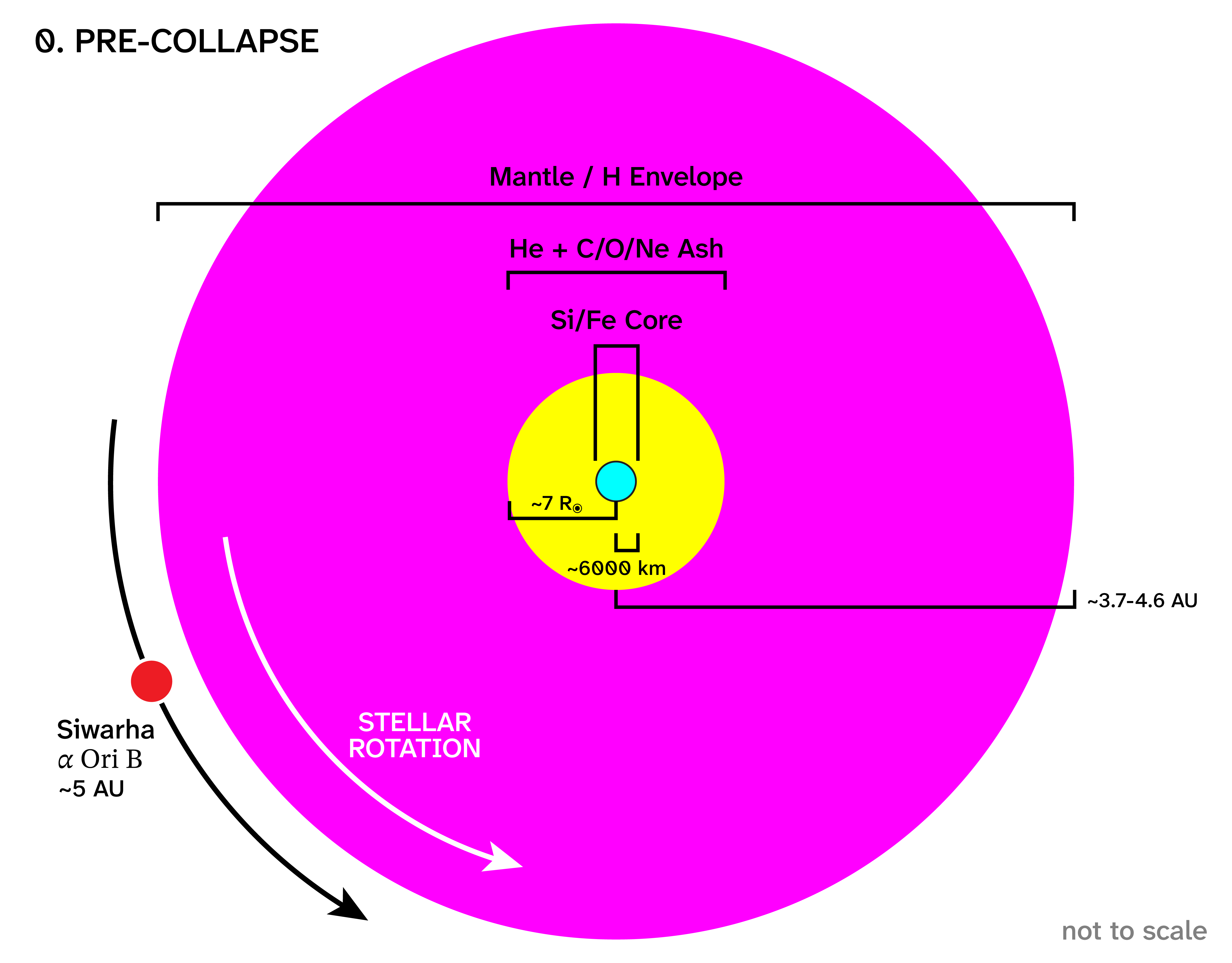 Betelgeuse’s structure before its collapse.
4.0 ~ Conceptual Revision
The Great Dimming and subsequent “recovery” were the visible signatures of a catastrophic structural failure deep within the star. The system has bifurcated into two distinct kinematic components: the Stagnation Torus (the collapsed ash shells) and the Delaminated Mantle (the infalling hydrogen envelope).
4.1 ~ Direct Collapse
The progenitor event was not a standard supernova ignition, but a failed supernova—a direct collapse to a singularity. In late 2019, the iron-silicon core of $\alpha$ Orionis grew to exceed the Tolman-Oppenheimer-Volkoff limit ($M_{TOV}$), the maximum mass a neutron star can support against gravitational collapse via degeneracy pressure.
\[M_{\text{core}} \approx M_{\text{Fe}} + M_{\text{Si}} \approx 2.2 M_{\odot} > M_{\text{TOV}} \approx 2.17 M_{\odot}\]In a standard Core-Collapse Supernova (CCSN), the core collapses to a proto-neutron star, bounces due to the sudden stiffening of the nuclear equation of state, and drives a shockwave outward that explodes the star. In this scenario, however, the mass was sufficient to overcome neutron degeneracy pressure. There was no bounce. The core collapsed instantly behind an event horizon ($R_s$).
\[R_s = \frac{2GM_{\text{core}}}{c^2} \approx 6.5 \text{ km}\]The physical consequence was the instantaneous cessation of the fusion engine and instantaneous global collapse of the iron core and (likely silicon) burning shell. The radiation pressure ($P_{rad}$) that had supported the overlying $15 M_{\odot}$ of stellar material vanished on the timescale of light crossing the core ($t \sim R/c \approx \text{milliseconds}$). This created a vacuum of support—a spacetime cavitation—at the center of the star. To the external universe, the engine did not sputter; it was deleted.
The nature of time around an event horizon implies that the singularity cannot form through a gradual “draining” process. Instead, we must model the pre-collapse core not merely as a dense gas, but as a metastable system under extreme tension, akin to a Prince Rupert’s Drop. Prior to failure, the degenerate iron-silicon core is held in a state of precarious equilibrium, where the outward stiffness of the quantum mechanical Equation of State (EoS) barely counterbalances the crushing weight of the star.
When the mass exceeds the critical limit ($M > M_{TOV}$), the system does not deflate like a punctured balloon or eat itself from the inside out; it shatters. The loss of pressure support is a global phase transition. Because the collapse velocity approaches the speed of light ($v_{collapse} \to c$), it exceeds the internal speed of sound ($c_s$) of the medium. The core loses causal connectivity with itself before it can mechanically rearrange. The fluid dynamics of the interior are instantly overwritten by the relativistic geometry of the collapse. Consequently, the event horizon does not grow outward from a central point; it crystallizes instantaneously at the Schwarzschild radius ($R_s$), freezing the causal structure of the core into the static 2D holographic surface of the singularity.
Timing
The alignment of the Fundamental Mode (FM) and Long Secondary Period (LSP) minima, which occurs every 42 years or so, reduced radiation pressure enough in the core that gravity overwhelmed the depleted burning shell. For a complete derivation of the timeline, see §5.0.
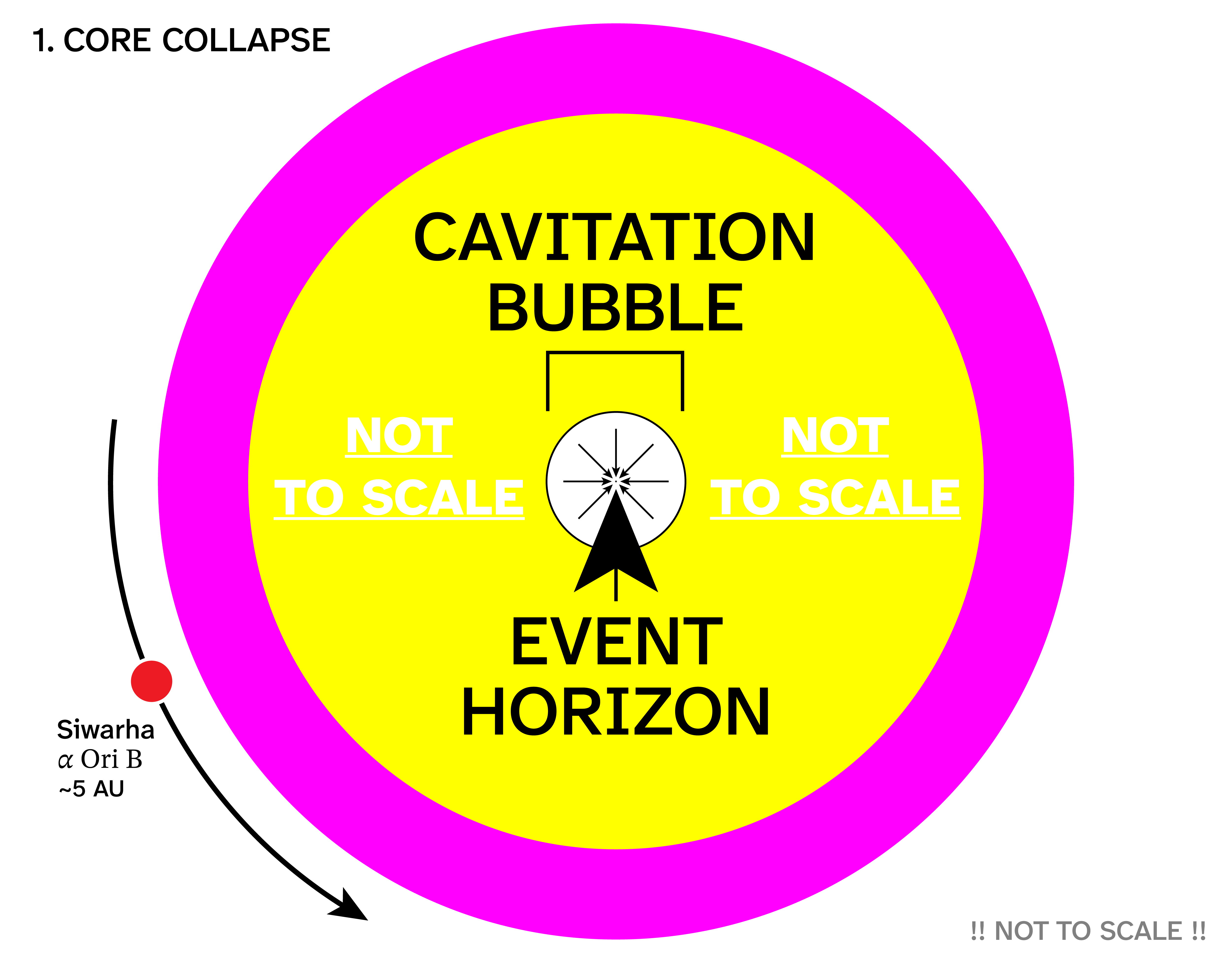 Core collapse
4.2 ~ Event Horizon & Time Wall
The collapse of the $2.2 M_{\odot}$ core established a rigid causal topology defined by the divergence of coordinate time. We identify two specific radii that govern the subsequent kinematics of the system:
-
The Event Horizon ($R_s$): The theoretical boundary of no return. \(R_s = \frac{2GM}{c^2} \approx \frac{2(6.67 \times 10^{-11})(4.38 \times 10^{30})}{(3.0 \times 10^8)^2} \approx 6.5 \text{ km}\)
-
The Time Wall ($R_{ISCO}$): The effective solid surface of the singularity in coordinate time, marking the outer boundary of the saturated Time Glass Region (TGR) above the event horizon, located at “ISCO”. \(R_{ISCO} = 3 R_s \approx 19.5 \text{ km}\)
For all infalling matter, the radial coordinate $r = 19.5 \text{ km}$ represents the absolute floor of the potential well. The collapse creates a hard, impenetrable sphere of relativistic impedance roughly 40 km in diameter.
I’m not interested in any Scotts down there or what they may be experiencing; as far as I can tell, there’s a relativistic fire bagel sitting on a wall of time ice between him and the horizon, and no amount of anyone’s time or schmear will get him through it safely.
4.3 ~ Ash Shell Collapse
Surrounding the collapsed iron core and burning silicon shell were concentric shells of oxygen, neon, and carbon—the ash of previous fusion cycles. These layers, extending out to $R \approx 1 R_{\odot}$ ($\approx 7 \times 10^5 \text{ km}$), were previously supported by the intense thermal pressure of the core.
When the core retreated behind the ISCO Time Wall, this support vanished. The ash shells found themselves suspended over a gravitational vacuum. With the pressure gradient term eliminated ($\nabla P \to 0$), the shells underwent a hydrodynamic catastrophe, transitioning instantly from hydrostatic equilibrium to supersonic freefall.
The duration of this collapse is defined by the freefall timescale ($t_{ff}$), derived from the density of the enclosed mass:
\[t_{ff} \approx \frac{\pi}{2} \sqrt{\frac{R^3}{2GM}}\]For a shell at $R \approx 1 R_{\odot}$ falling onto a $2.2 M_{\odot}$ core: \(t_{ff} \approx \frac{\pi}{2} \sqrt{\frac{(7 \times 10^8 \text{ m})^3}{2(6.67 \times 10^{-11})(4.4 \times 10^{30})}} \approx 900 \text{ s} \approx 15 \text{ minutes}\)
Inner shells at $R \approx 10,000$ km fell in roughly 1 second.
This establishes the kinematic reality of the event: The collapse of the stellar interior was a violent, implosive snap that occurred faster than the overlying hydrogen envelope could causally process it. The heart of the star vanished before the musculature had time to find out it was dead.
When the ash shells dropped out, they delaminated from the mantle. See §4.5 for more.
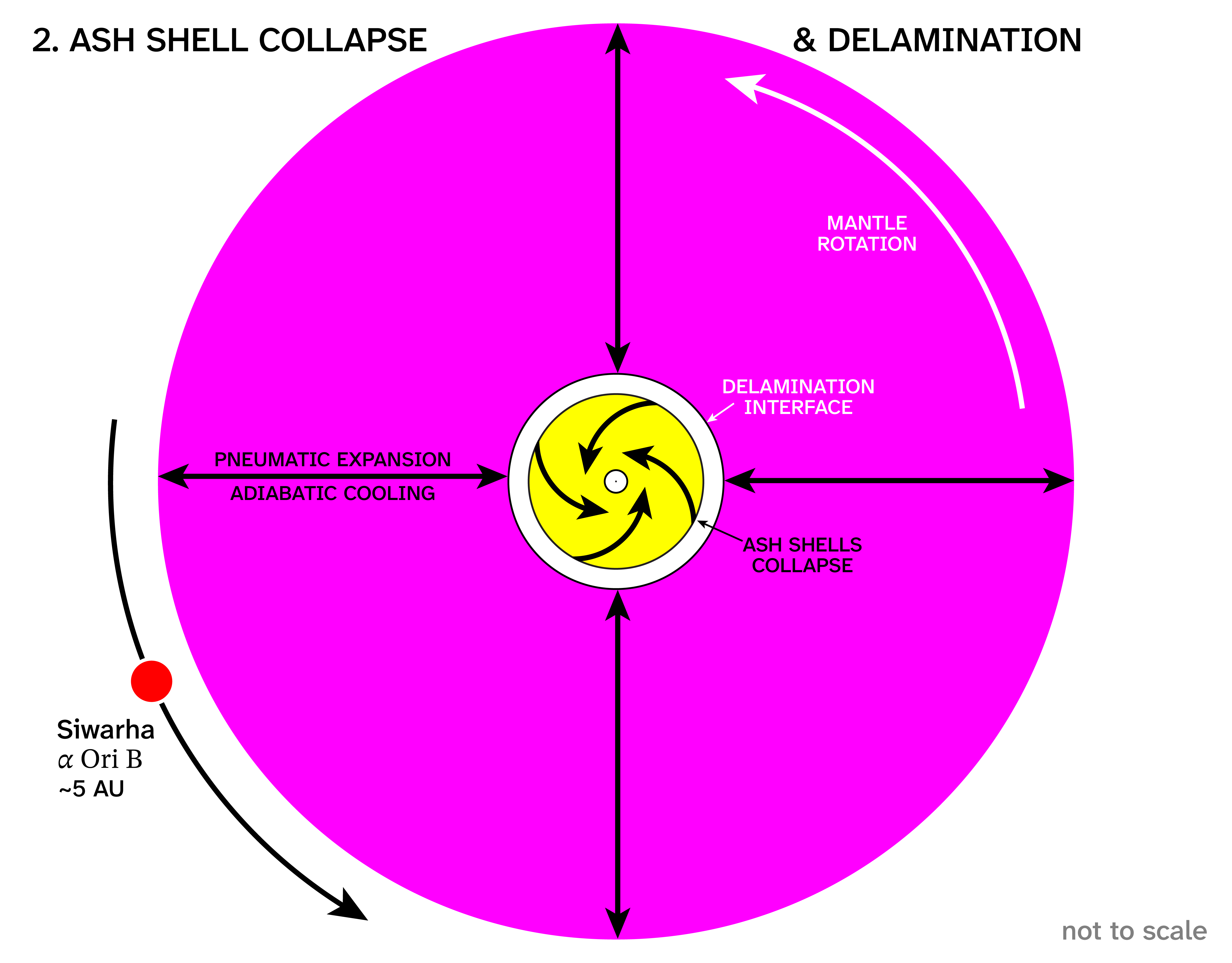 Ash shell collapse and delamination dynamics
4.4 ~ Torus Formation
The infalling ash did not strike the ISCO Time Wall directly. The progenitor star possessed intrinsic rotation, and the collapse preserved the specific angular momentum ($j$) of the falling shells.
\[j = v_{\phi} r = \text{constant}\]As the ash shells collapsed from $R \sim 7 \times 10^5 \text{ km}$ to $R < 2000 \text{ km}$, conservation of angular momentum accelerated their rotational velocity to relativistic speeds. Infall was arrested at the circularization radius ($R_{circ}$), the point at which the centrifugal force exerted by this rotation counterbalanced the gravitational pull of the singularity.
\[\frac{j^2}{R_{circ}^3} = \frac{GM}{R_{circ}^2} \implies R_{circ} = \frac{j^2}{GM}\]At this boundary ($R_{circ} \approx 1000 \text{ km}$), the supersonic freefall shocked against the centrifugal barrier, transforming the ordered kinetic energy of the collapse into a turbulent, high-density, RAD PSUDO-TORCH (RADiation PreSsUre-DOminated TORus of exCeedingly Hot ice).
Just kidding, Stagnation Torus.
Initially, this structure was radiatively cold. It held the energy of the collapse almost entirely as bulk rotational kinetic energy. To become a luminous source, the Torus had to undergo virialization—the conversion of ordered rotation into random thermal heat via differential rotation and magnetic friction (viscosity, $\nu$).
The Stagnation Torus is hot, turbulent, and rotating because it is trying to shed its infall energy and angular momentum against a temporal surface that is too dilated to receive it.
The observed 45-day delay between the initial dimming (Dec 2019) and the optical recovery (Feb 2020) corresponds to the viscous timescale ($\tau_{visc}$) required for this friction to heat the Torus to X-ray emitting temperatures.
\[\tau_{visc} \sim \frac{R_{circ}^2}{\nu}\]During the Great Dimming, Betelgeuse died completely and a new power filled its void. It took roughly 15 days after the initial collapse for internal friction to process the ash into radiating plasma, which then re-illuminated the system from the inside out. The system had sort of metastabilized by March 2020.
4.5 ~ Tides, Pneumatics & Adiabatics
The structural failure of the star was governed by a fundamental discontinuity in its composition. A red supergiant is defined by a distinct, high-density Helium core ($M_{He} \approx 6 M_{\odot}$) surrounded by a tenuous Hydrogen envelope ($M_{H} \approx 12-15 M_{\odot}$). The interface between these regions—located at $R \approx 7 R_{\odot}$ ($4.9 \times 10^{11}$ cm)—acts as a density cliff.
Across this boundary, the stellar density drops by 9 (!!) orders of magnitude, from $\rho_{core} \approx 10^4 \text{ g/cm}^3$ to $\rho_{env} \approx 10^{-5} \text{ g/cm}^3$. This creates a total decoupling of the dynamical timescale ($\tau_{dyn}$) during the collapse event: \(\tau_{dyn} \approx \sqrt{\frac{1}{G\rho}}\)
- The Core ($R < 7 R_{\odot}$): Stellar-core density implies a reaction time of minutes; it fell instantly.
- The Envelope ($R > 7 R_{\odot}$): Vacuum-like density implies a reaction time of weeks; it had too much rotational inertia to follow the core.
I define the Delamination Interface at this structural seam: $R_{tear} \approx 7 R_{\odot}$.
When the pressure support vanished, the core detached from the envelope. This separation was exacerbated by the companion star, $\alpha$ Ori B (Siwarha), located at periastron ($\approx 5$ AU). The companion’s tidal potential bulged the mantle behind it and anchored the skin gravitationally ($R > 800 R_{\odot}$), effectively holding the roof up while the floor dropped out. Without Siwarha, the mantle would have fallen immediately, and we would have been having this conversation during the pandemic.
The result was pneumatic withdrawal. The deep mantle was forced to expand inward to fill the rapidly growing vacuum left by the core. This expansion was adiabatic ($dQ = 0$); the gas performed work to fill the void, consuming its own thermal energy.
\[T_{final} \approx T_{initial} \left( \frac{V_{initial}}{V_{final}} \right)^{\gamma - 1}\]The Great Dimming was the optical result of the mantle’s flash-cooling from pneumatic expansion and core radiation cessation.
Direct singularity formation and mantle delamination explains the dramatic and sustained collapse of Betelgeuse’s Fundamental Mode (FM) to—largely—the first overtone: the core is no longer present to pulsate and sustain the FM, so the mantle’s dynamic overtone is driving the pattern.
If a dust cloud or starspot had caused the dimming, we would expect no change in the Fundamental Mode after luminosity recovery.
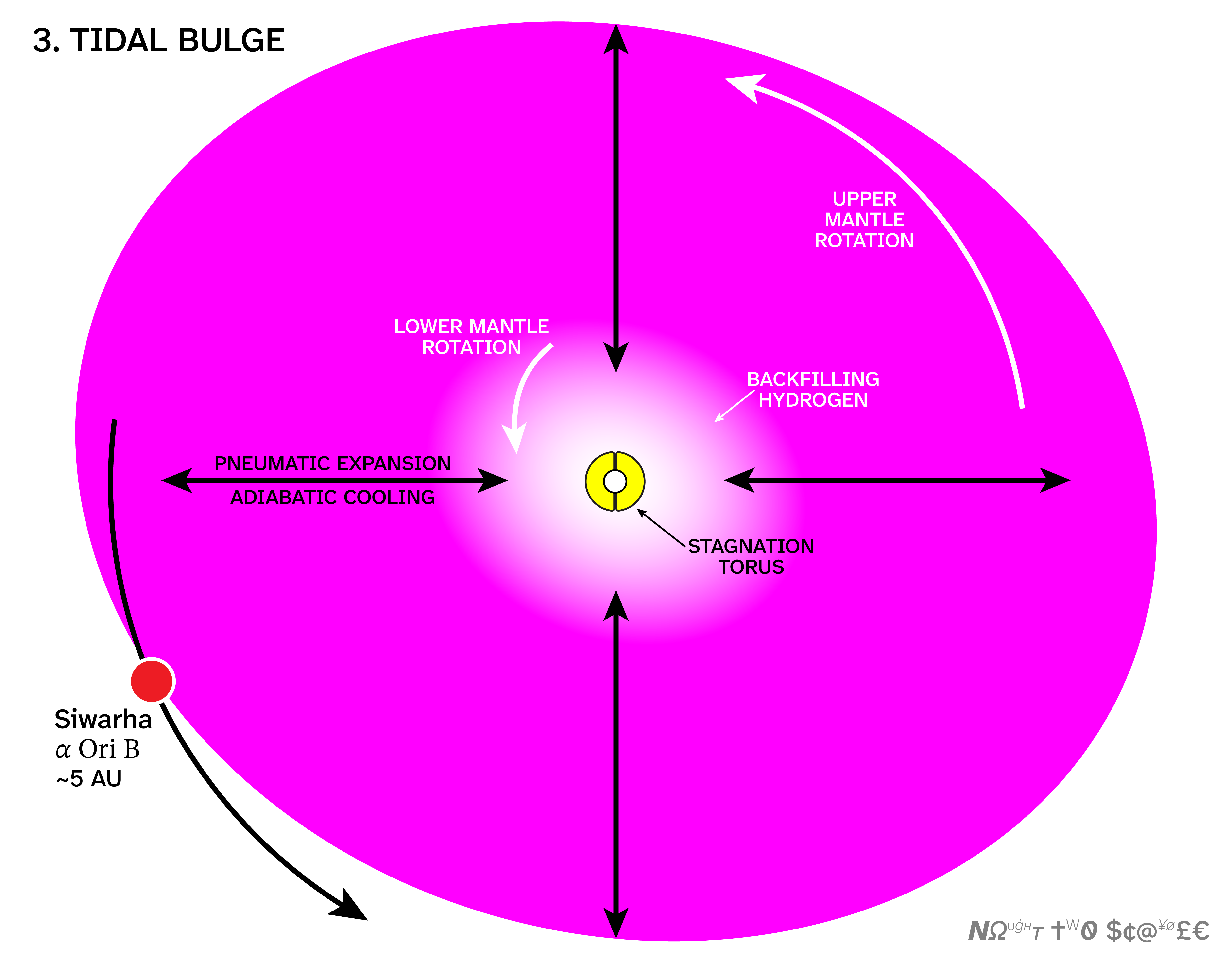 The tidal bulge of Betelgeuse’s mantle trails Siwarha because Siwarha orbits faster than Betelgeuse’s rotation. This applies constant torque to the mantle. Stagnation Torus is shown perpendicular to its relative orientation for illustrative effect.
4.6 ~ Dimming Event
The observational signature of this internal catastrophe was the “Great Dimming” of late 2019. Conventional models struggled to explain the event because they assumed a constant stellar radius ($R$):
- Dust Hypothesis: Required material to travel faster than observed outflow velocities to reach the condensation zone.
- Starspot Hypothesis: Required a global temperature drop of $\Delta T \approx 840 \text{ K}$ to match the dimming. Observations showed only $\Delta T \approx 50 \text{ K}$.
GBT resolves this by asserting that the effective radius ($R_{eff}$) was not constant. The luminosity decline was driven by the receding photosphere mechanism.
As the delaminated mantle underwent adiabatic expansion and cooling (see §3.5), the ionization fraction of the hydrogen envelope dropped. The opacity of the outer layers—primarily governed by $H^{-}$ ions—plummeted as electrons recombined. \(\kappa \propto \rho T^{n}\) As the gas cooled, it became transparent. The “surface” of the star (the radius where optical depth $\tau \approx 2/3$) retreated inward. We were not watching the star get colder; we were watching the visible star get smaller. The opaque, light-emitting shell receded from the physical boundary ($R \approx 900 R_{\odot}$) toward the collapsing interior.
The minimum of the light curve (February 2020) represents the reversal: the moment when luminosity loss from the receding photosphere was balanced by luminosity gain from the newly ignited Stagnation Torus (see §3.4). \(\frac{dL_{cool}}{dt} + \frac{dL_{heat}}{dt} = 0 \quad (\text{Feb 2020})\) The subsequent recovery was the grind of the Stagnation Torus punching through the diffuse ghost of the mantle, re-illuminating the gas from within and making it appear, for a while, like a living star—but it was already dead.
4.7 ~ Impact Event
Since the Delamination event in December 2019, the bulk Hydrogen mantle ($12-15 M_{\odot}$) has been in a state of ballistic freefall. Siwarha’s gravity puffed up the mantle exactly when the core collapsed, which prevented it from sinking immediately, but it has since been accelerating downwards towards a relativistic obstruction. The floor of the well—as far as anyone outside it is concerned—is now the surface of the Stagnation Torus—a high-density, rotating plasma barrier located at the Circularization Radius ($R \approx 1000 \text{ km}$).
As the mantle descends from $\approx 6 \text{ AU}$ to $1000 \text{ km}$, it converts gravitational potential energy into kinetic velocity. At the moment of impact, the infall velocity ($v_{impact}$) is defined by the depth of the potential well relative to the speed of light:
\[v_{impact} \approx c \sqrt{\frac{R_s}{R_{torus}}} \approx c \sqrt{\frac{6.5 \text{ km}}{1000 \text{ km}}} \approx 0.08c\]The envelope will strike the torus at roughly 8% of the speed of light.
The energy released by this collision is calculated by the conversion of the bulk kinetic energy of the falling mass ($M_{mantle} \approx 13 M_{\odot}$) into thermal energy upon stagnation.
\[E_{kinetic} = \frac{1}{2} M_{mantle} v_{impact}^2 \approx \frac{1}{2} (2.6 \times 10^{34} \text{ g}) (2.4 \times 10^9 \text{ cm/s})^2 \approx 7.5 \times 10^{52} \text{ erg}\]This energy yield exceeds that of a standard Type II Supernova ($10^{51}$ erg) by nearly two orders of magnitude. The Gravity Bomb is a kinetic-to-thermal conversion event. The system is effectively hammering, at nearly 10% the speed of light, several stars’ worth of compressed gas onto a relativistic anvil the size of a very small planet. The resulting heat will vaporize infalling gas coming in behind, and generate a luminous transient that rivals the galaxy’s collective output.
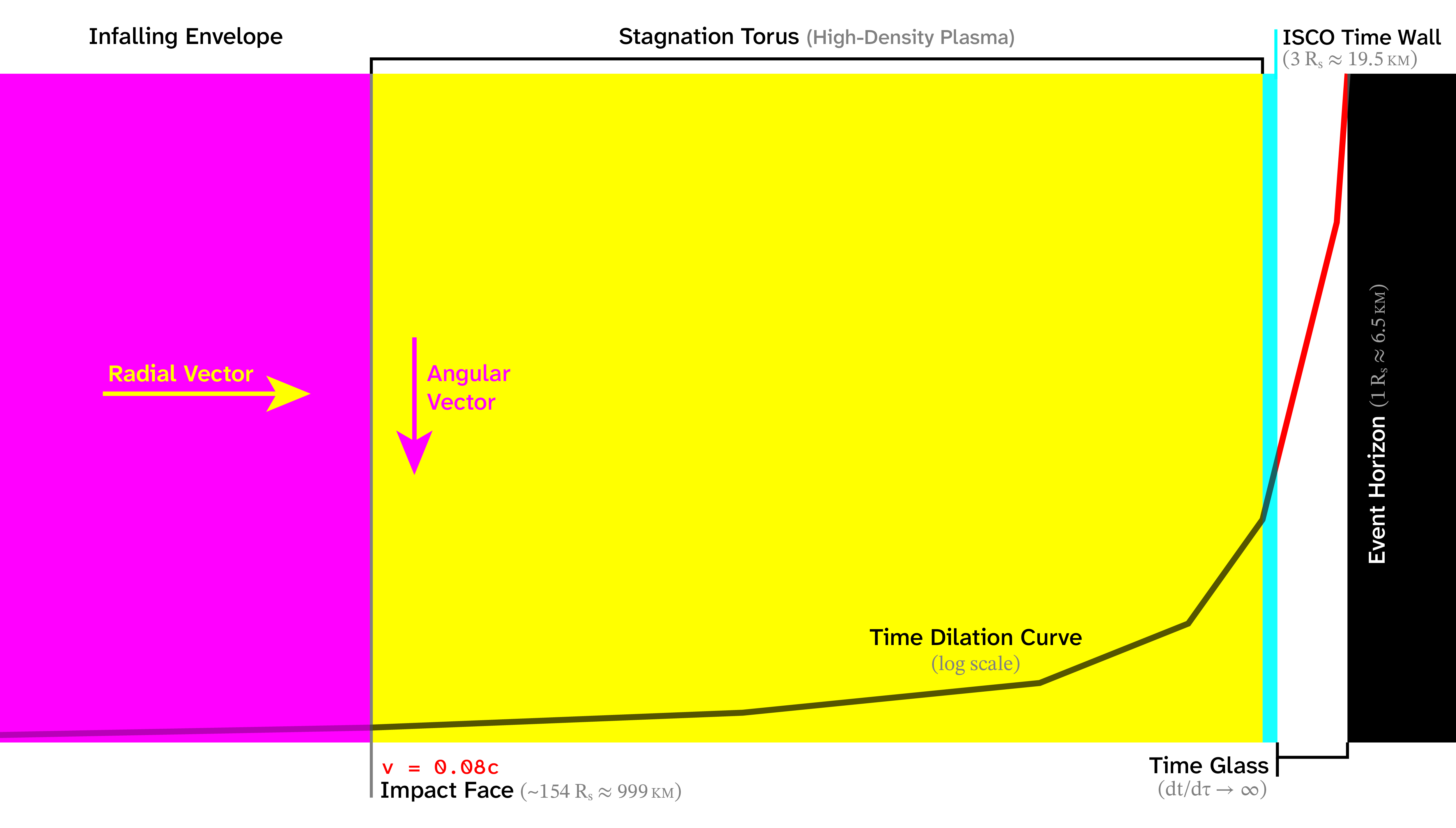 Dynamics of Stagnation Torus, Time Wall, Time Glass, and Event Horizon relative to Time Dilation curve
The Predictions
5.0 ~ The LSP Clock
Why six years? A standard gravitational freefall from $800 R_{\odot}$ onto a $2 M_{\odot}$ remnant would take approximately 100 days ($t_{ff} \approx \pi/2 \sqrt{R^3/2GM}$). However, this assumes a static, isolated system. Betelgeuse is neither.
The 2019 collapse coincided perfectly with the minimum of the Long Secondary Period (LSP), a $\approx 2170$-day photometric cycle driven by the $\approx 2190$-day orbital resonance of the companion star, Siwarha ($\alpha$ Ori B). At the moment of core failure ($P_{rad} \to 0$), the outer mantle was not merely suspended; it was under maximal tidal tension from the companion.
Instead of a direct vertical collapse, the mantle was lofted into a ballistic trajectory determined by the companion’s period. The envelope was effectively handed off from the internal engine (which died) to the external orbital clock (which persisted).
We calculate the impact date as the completion of exactly one dead cycle—a single ballistic oscillation of the tidally detached envelope.
\[T_{impact} = T_{collapse} + P_{LSP}\]- $T_{collapse}$: December 15, 2019 (approximate center of the Great Dimming initiation).
- $P_{LSP}$: $2190 \pm 30$ days (6.0 years, consistent with recent interferometric observations of the companion’s orbit).
This defines the primary impact window between late November and late December 2025. I have centered the prediction on 15 December for the neutrino precursor (impact start) and 21 December for the optical maximum, aligning with the Solstice for geometric elegance, though the mechanics allow for a $\pm 14$-day variance.
5.1 ~ Neutrino Precursor
Estimated Arrival: 15 December 2025 (00:00 UT)
The first material to strike the Stagnation Torus is the leading edge of the envelope. Because this material impacts the relativistic impedance of the torus at $v \approx 0.08c$ while the density is still low, the collision generates a collisionless shock capable of efficient Fermi acceleration.
- Physics: Protons trapped in the magnetic turbulence of the torus are accelerated to TeV-PeV energies, producing a blast of high-energy neutrinos.
- Signal: This is a saturation event. The flux will overwhelm background noise entirely. I predict $>100,000$ high-energy track events within the precursor window, effectively lighting up the entire cubic-kilometer volume of IceCube.
5.2 ~ Hard Flash
Estimated Arrival: 15 December 2025 (~01:00 UT)
Immediately following the neutrino burst, the bulk mantle strikes the torus. The kinetic energy ($7.5 \times 10^{52}$ erg) is thermalized instantly. A prompt Gamma-Ray and X-Ray shockwave propagates outward at $c$, crossing the “vacuum gap” to the stellar surface ($\approx 900 R_{\odot}$) in less than an hour.
- Signal: The outer skin of the star will undergo prompt fluorescence, emitting a violent burst of hard UV and soft X-rays.
- Visibility: This flash will be invisible to the naked eye due to atmospheric absorption (ozone layer). However, high-energy space observatories (Swift, Fermi, MAXI) will register a blinding, detector-saturating transient.
5.3 ~ Optical Breakout
Estimated Arrival: 21 December 2025 ($T_{impact} + 144h$)
While the explosion occurs on Dec 15, the visual transient is delayed by optical diffusion. The infalling mantle will have been crushed into a shell of extreme density. Photons generated at the Torus surface are trapped in this proton prison, unable to free-stream until the fireball expands and cools sufficiently for the opacity to drop.
We estimate the diffusion time ($t_{diff}$) using the Arnett approximation for optically thick transients, modified for the high-density environment of the Stagnation Torus:
\[t_{diff} \approx \frac{\kappa M_{shell}}{c R_{eff}}\]However, a more parsimonious derivation for a relativistic stagnation shock considers the shock crossing time coupled with the thermalization rate. The light cannot escape until the shock front propagates through the densest accumulating layers of the falling tail.
Given an impact velocity $v \approx 0.08c$ and a characteristic accumulation depth of the initial high-density wave ($\Delta R \approx 10^7$ km), the breakout lag is:
\[t_{lag} \approx \frac{\Delta R}{v_{shock}} \times \tau_{geo}\]Modelling the geometric opacity factor ($\tau_{geo}$) for the compressed hydrogen/helium mix suggests a diffusion barrier that holds the luminosity for approximately 140 to 150 hours.
- Result: A 6-day dark interval between the neutrino spike/X-ray flash (the crash) and the optical blooming (the fireball). This delay is the final signature of the event’s high-density, relativistic nature.
- Event: On or around the Winter Solstice, 21 December 2025, the thermal wave will finally break out of the expanding cloud. The star will brighten from Magnitude +0.5 to its peak luminosity in a matter of hours.
- Magnitude: I predict a peak visual magnitude of $M_V \approx -14$.
- Spectacle: The star will appear 10 to 15 times brighter than the Full Moon. It will be visible in broad daylight, casting sharp shadows at night, dominating the winter sky for up to weeks before fading.
5.4 ~ Summary of Sequence
| Date | Event | Mechanism | Observable |
|---|---|---|---|
| 15 Dec | Core Impact | Fermi Acceleration | Neutrinos (IceCube Saturation) |
| 15 Dec | Shock Breakout | Fluorescence | X-Ray/UV (Satellites Only; Invisible to Eye) |
| 16-20 Dec | (re)Dimming | Photon Trapping | None (Star may appear chaotic/dim) |
| 21 Dec | Visual Peak | Optical Diffusion | -14 Mag (Daylight Visible) |
5.5 ~ “Reach” Prediction lol
While the primary GBT framework relies on classical kinetic-to-thermal conversion ($E \approx \frac{1}{2}mv^2$), I suspect the mantle’s impact on the Stagnation Torus will be powerful enough—in combination with the Torus’s magnetic field—to produce antimatter.
Given the relativistic infall velocity ($v \approx 0.08c$) and the surely gigagauss-strength magnetic fields of the Stagnation Torus, the shock front is likely a site of extreme Fermi acceleration, as I alluded in §4.1 above. I hypothesize that a significant fraction ($\eta \sim 10^{-3}$) of the infalling protons may be accelerated to energies exceeding the threshold for pair production ($E_p > 6 \text{ GeV}$), generating a transient population of hadronic antimatter ($p\bar{p}$).
The immediate annihilation of this antimatter component would inject a secondary source of hard gamma radiation ($E_{\gamma} \approx 10^{50}$ erg) directly into the shock base. This acts as a radiative supercharger, creating an over-pressure zone that accelerates the envelope expansion beyond standard thermal velocities.
If this mechanism is active, the observable transient will deviate from the thermal diffusion model:
- Duration: The plateau phase will collapse. The transient will be significantly shorter (< 1 week).
- Luminosity: The peak magnitude will exceed thermal limits, potentially reaching $M_V \approx -16$.
- Spectrum: The optical transient will be accompanied by a detectable gamma-ray excess that persists longer than the initial flash, signalling ongoing particle interaction in the debris field.
The Conclusion
I stand by my work. Where I diverge from the consensus interpretation of physics, I am confident my interpretation is the more-parsimonious and explanatory. It is okay to set the paradigm on the shelf for a moment to evaluate this new idea on its own merits.
I have presented a unified hydro-gravitational framework that resolves the anomalies of $\alpha$ Orionis (Betelgeuse) observed since late 2019. By discarding the assumption of hydrostatic equilibrium and treating the Great Dimming as the adiabatic signature of core-mantle delamination, I derive a coherent causal sequence: Core Collapse ($M > M_{TOV}$) $\to$ Pneumatic Withdrawal $\to$ Stagnation Torus Virialization.
The necessary conclusion is that we have been observing a zombie star for the last six years. The core is gone; the mantle is a hollow shell, temporarily suspended by the tidal gravity of its companion.
This model rests on the primacy of Coordinate Time. In recognizing the impossibility of coordinate causality in the Time Glass Region and the conceptual vacuousness of Proper Time, we bypass the paradigmatic failure that produces the information paradox, and generate a coherently predictive and explanatory model of Betelgeuse’s Great Dimming.
The $13 M_{\odot}$ hydrogen envelope is currently executing a Cosmic Belly Flop. It is accelerating to relativistic speeds ($0.08c$) on its way to striking the absolutely rigid and immovable Stagnation Torus.
The timing of this terminal transient is governed by the LSP Clock. The mantle was lofted into a ballistic trajectory by the companion star (Siwarha) at the moment of the 2019 collapse. It is now completing exactly one “dead cycle” of freefall.
I forecast a high-energy kinetic-to-thermal conversion event of $E \approx 7.5 \times 10^{52}$ erg:
- 15 December 2025: A high-energy neutrino saturation event and X-ray flash marking the impact.
- 21 December 2025: A visual breakout rising to magnitude -14, visible in broad daylight, following a 6-day optical diffusion lag.
If this framework is correct, the Great Dimming was not a weather event, but the start of a six-year calm before the cosmic storm. Scientists need to look down at their neutrino detectors on Monday, December 15; the world needs to look up towards Orion on the Solstice.
But even if you don’t, you won’t be able to miss it.
If I’m wrong about all of this, at least I was willing to look at the evidence with fresh eyes and an open mind, and offer a novel and coherent model to explain it.
Whatever happens, I won’t regret taking this stand. And I’ll still be less wrong than Dust Clouds and Starspots.